Showing posts with label Single Family Housing. Show all posts

Friday, October 7, 2016

How Many Bathrooms in the Typical New Home?

The share of new single-family homes with three or four full bathrooms has increased in the last several years, according to the latest Survey of Construction data from the U.S. Census Bureau.

As National Association of Home Builders economist Carmel Ford reports in a recent Eye on Housing blog post, this trend may reflect the move by builders to focus on higher-end, larger homes in the post-recession period. However, recent data indicate that this trend started to reverse: the median square feet of new homes declined in the second quarter of 2016. Growth in the number of smaller homes, such as townhomes, may emerge going forward in response to first-time buyers returning to the market.

Of new single-family homes started in 2015, 4% have one or less full bathrooms, 59% have two full bathrooms, 27% have three full bathrooms, and 10% have four or more full bathrooms.

The Figure 1 chart below shows that from 2005 to 2015 the share of new homes with two full bathrooms or less edged downward while the percentage of new homes with three or four full bathrooms increased.

View the Eye on Housing blog post for more details.


Tuesday, May 31, 2016

Builder Breakfast on June 9th

Join us at Hubbell Lighting (701 Millennium Blvd) on June 9th from 7:30-9 a.m. for our quarterly Builder Breakfast. This time we will have building officials from Greenville County to discuss the new single family permit regulations that became effective in March, along with a few other topics. Please register here to save your spot and complimentary breakfast.

This event is for Builder Members and Builder affiliates only.

Tuesday, March 22, 2016

Single-Family Housing Starts Reach Highest Level Since November 2007

Nationwide housing starts rose 5.2% to a seasonally adjusted annual rate of 1.178 million units in February, according to newly released data from Housing and Urban Development and the Commerce Department. Single-family production increased 7.2% to 822,000 units, its highest level since November 2007, while multifamily starts edged up 0.8% to 356,000 units.

“This month’s report is consistent with positive builder sentiment and other economic indicators showing that the housing market continues to recover at a gradual pace,” said National Association of Home Builders Chairman Ed Brady.

“February’s single-family gains indicate that this sector is strengthening in line with our forecast,” said National Association of Home Builders Chief Economist David Crowe. “As the U.S. economy firms, job creation continues and mortgage interest rates remain low, we should see further growth in housing production moving forward.”

Combined single- and multifamily starts rose in three of the four regions in February, with the West, Midwest and South posting respective gains of 26.1%, 19.9% and 7.1%. The Northeast registered a 51.3% loss.

A decline in the volatile multifamily sector pushed overall permit issuance down 3.1% in February. Multifamily permits fell 8.4% to a rate of 436,000 while single-family permits ticked up 0.4% to 731,000.

Regionally, permits increased in the Northeast by 40.4 %. The Midwest, West and South registered respective permit losses of 11.4%, 7.2% and 4.4%.

Friday, July 11, 2014

Renewable Energy in New Homes

A rising number of new homes include renewable energy features, a trend that is apparent in both single-family and multifamily construction. McGraw Hill Construction’s data and analytics team surveyed a set of NAHB single-family and multifamily members in 2013.
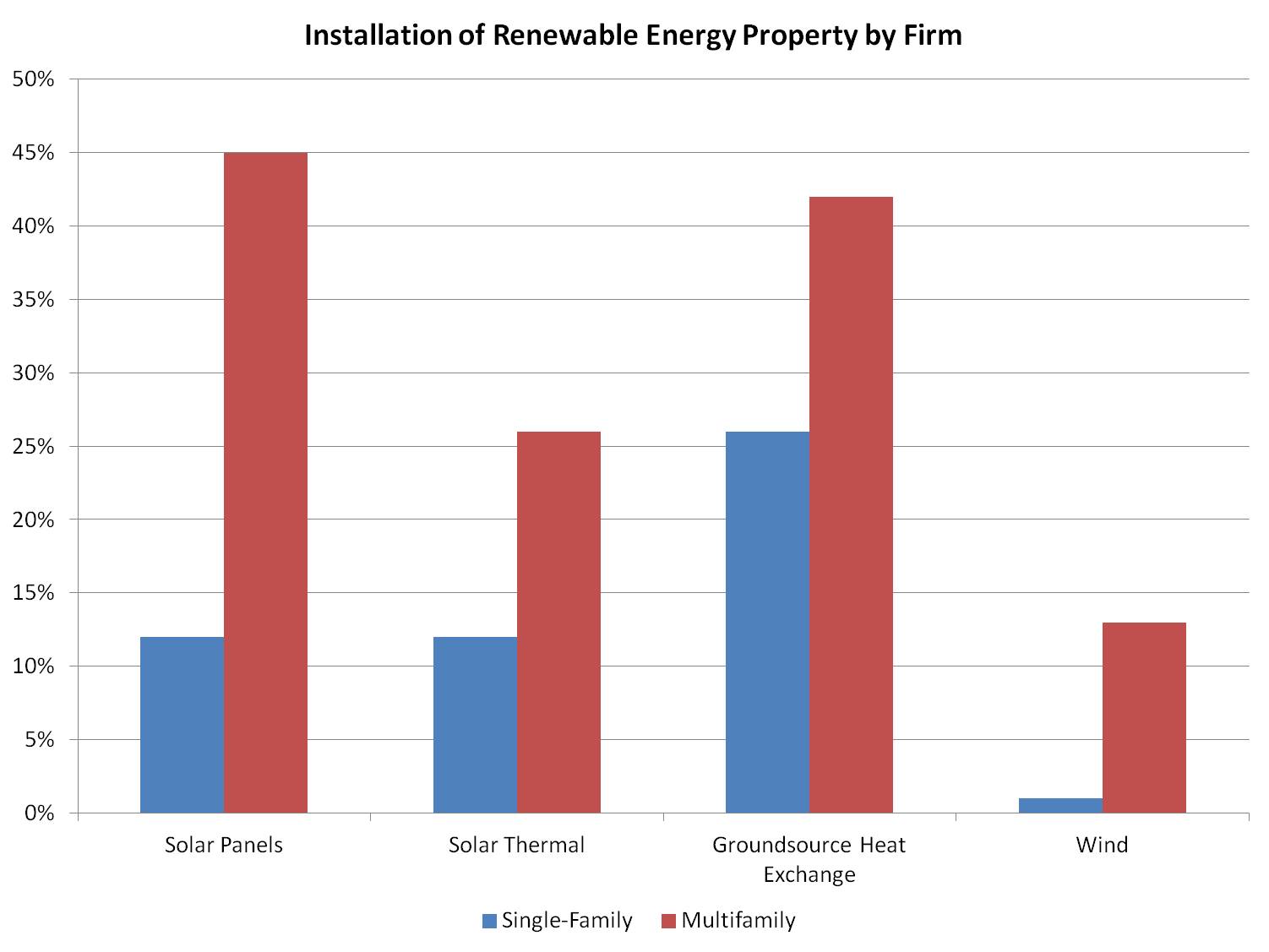
According to the findings, 12% of single-family builders reported including solar photovoltaic panels in new home construction in 2013. More popular for single-family construction was geothermal groundsource heat exchange property, used for some projects by 26% of home builders. Wind power is less popular, with only 1% of single-family builders reporting its use.

renewable energy property
Multifamily developers were more likely to use these power production features in at least some of their projects. For example, 45% of multifamily developers used solar panels, 42% installed geothermal property in some projects and 13% reported using wind turbines.
That said, the frequency of use of these items was more common on the single-family side of the market, perhaps due to incentives like the section 25D power production tax credit for new and existing homes. More than half of single-family builders who report installing solar panels do so on more than 25% of their projects. And more than 75% of single-family builders who install geothermal property do so on more than 25% of their homes.
In contrast, for multifamily developers who report installing solar panels, more than 75% do so on fewer than 25% of their projects. And nearly all multifamily developers who report using geothermal do so on fewer than 25% of their properties.

Thursday, October 25, 2012

NAHB's fall construction forecast provides an upbeat tone.

Chief Economist David Crowe and his fellow presenters at NAHB's fall construction forecasting event carried a mostly upbeat tone. The focus of the event was regarding the housing industry and the evolution of housing finance policies. The speakers noted that the most recent data seems to be "in sync" with the notion that a recovery is truly underway. Much of the multifamily and single family remodeling has made considerable progress toward returning to  pre-down turn levels. Stating that remodeling is already back to 100% of production relative to 2000-2002 spending and multifamily is at 64%, and single family is around 40% of normal production. However, Crowe noted that weak job growth, credit issues, and appraisal problems continue to slow the pace of recovery. This forecast is contingent on Congress coming up with a solution to avoid the "fiscal cliff" posed by mandated government spending cuts.  
This year, Crowe is projecting that single-family starts will finish this year at 528,000 units, then rise 26% to 665,000 units in 2013 and another 30% to 865,000 units in 2014. Meanwhile, he expects multifamily starts to finish 2012 with 224,000 units, followed by a modest rise to 238,000 units in 2013 and another gain to 275,000 units in 2014. 

The longest to recover will be the local markets, because those were the hardest hit in the housing downturn. 

Areas that are at "normal" housing production levels include North Dakota, Washington, D.C., and parts of Wyoming and Texas. 

For more information or to read the full article please see NAHB Monday Morning.  

Friday, January 20, 2012

NAHB: Single-Family Housing Starts Rise 4.4 Percent in December

Nationwide production of new single-family homes rose 4.4 percent to a seasonally adjusted annual rate of 470,000 units in December, according to newly released figures from the U.S. Commerce Department. This marked a third consecutive increase and the fastest pace of single-family housing starts since April of 2010. Meanwhile, the overall number of housing starts for the month declined 4.1 percent to a 657,000-unit rate due to a 20.4 percent dip on the more volatile multifamily side.

“Today’s report adds to the growing evidence that demand for new, single-family homes is finally starting to firm up in an increasing number of markets nationwide,” said Bob Nielsen, chairman of the National Association of Home Builders (NAHB) and a home builder from Reno, Nev. “This emerging trend is allowing builders to put more crews back to work, and could be even stronger if not for the overly tight credit conditions that prevail for both builders and buyers, as well as the continuing foreclosure crisis and the challenges of obtaining accurate appraisal values on new homes. Policymakers should be doing everything possible to alleviate these problems and nurture the fledgling housing recovery in order to promote job and economic growth.”

“This report is in keeping with our expectations for slow but steady improvement in the single-family market, where production hit its lowest yearly rate in over 50 years in 2011,” said NAHB Chief Economist David Crowe. “Meanwhile, it should be noted that the decline in multifamily starts in December was coming off a dramatic increase from the previous month and simply brought that sector back closer to trend. Apartment production generally continues to gain strength heading into 2012 after posting a more-than 50 percent gain in 2011.” Looking forward, NAHB is forecasting gains of approximately 17 percent in both single- and multifamily housing production in 2012.

Combined single- and multifamily housing starts fell 4.1 percent to a 657,000-unit rate in December due to the multifamily side retreating 20.4 percent from a big gain in the previous month, to a seasonally adjusted annual rate of 187,000 units. However, for the year as a whole, overall housing production was pegged at 606,900 units, which was 3.4 percent better than the overall number of starts in 2010.

Regionally, December housing starts rose 54.8 percent in the Midwest following a big decline in the previous month. The Northeast posted a 41.2 percent decline that offset a big gain in the previous month, while the South and West also posted declines of 3.0 percent and 17.6 percent, respectively.

Permit issuance, which can be an indicator of future building activity, held virtually flat at a 679,000-unit rate in December. Single-family permits rose for a third consecutive month, by 1.8 percent to 444,000 units, while multifamily permits declined 3.7 percent to 235,000 units.

Regionally, permits rose 5.8 percent in the Midwest and held unchanged in the West, but declined 6.5 percent in the Northeast and 0.6 percent in the South in December.