In a move that could affect our multifamily members, Housing and Urban Development issued a proposed rule today to revise its regulations for the Section 542(c) Housing Finance Agencies Risk-Sharing Program.
The program provides credit enhancement for mortgages of multifamily housing projects whose loans are underwritten, processed, serviced and disposed of by housing finance agencies (HFAs). HUD and HFAs share in the risk of the mortgage, which enables HFAs to provide more insurance and credit for multifamily loans.
Under the program, qualified state and local HFAs may originate and underwrite affordable housing loans that include new construction, substantial rehabilitation, refinancing and housing for the elderly. HFAs may elect to share 10%-90% of the loss on a loan with HUD. In the event of a claim, the HFA reimburses HUD pursuant to terms of the risk-sharing agreement.
This proposed rule would amend existing regulations for the program so that they better align with policies for other HUD programs, reflect current industry and HUD practices, and conform to statutory amendments.
Additionally, this proposed rule would provide HUD with greater flexibility in operating the Section 542(c) HFA Risk-Sharing program over time, and would provide more flexibility for certain HFAs accepting a greater share of the risk of loss on mortgages insured under the program.
HUD is providing only a 30-day comment period. Comments are due on or before April 7.
NAHB will review this proposed rule in consultation with the Multifamily Finance Subcommittee. Members who wish to offer feedback for consideration as part of the Home Builders Association’s comments should email Michelle Kitchen at mkitchen@nahb.org.

The Home Builders Association of Greenville are your neighbors and community leaders providing education and support for building industry professionals. We create jobs, encourage homeownership, and promote responsible growth throughout the upstate of South Carolina.
Showing posts with label multi-family housing. Show all posts
Showing posts with label multi-family housing. Show all posts
Wednesday, March 9, 2016

Thursday, September 3, 2015
New Study Confirms Growing Rental Demand
Here is some good news for the multifamily building industry: The national rental vacancy rate hit 7.6 percent in 2014, the lowest in nearly 20 years, according to a new report from the Joint Center for Housing Studies at Harvard University.
Released today, the 2015 State of the Nation’s Housing highlights the continuing demand for rental housing, particularly for Generation X and millennials, as these younger households still prefer renting over buying.
It forecasts that among individuals now under age 30, there will be 20 million new households between 2015 and 2025, and while the majority of these newly formed households will move into rental housing, that demand will eventually spill over into homeownership. Minorities are expected to be responsible for 85 percent of the net household growth over the next 20 years.
In the meantime, however, rent burdens are growing: Almost half of renters in 2013 paid more than 30 percent of their income for housing, while a quarter of households were severely burdened, paying more than 50 percent of their income for housing.
The report also details how that as baby boomers move into retirement years, most expect to remain as single-family home owners. The Joint Center notes that by 2025, the growing population of seniors is likely to increase demand for housing that offers “a combination of affordability, accessibility, and supportive services.”
One thing that stays the same: Housing remains key to net worth. “For the typical home owner, home equity remains a key source of household wealth, accounting for $80,000 of the $195,500 median net wealth of home owners in 2013, while the median net wealth of renters was just $5,400,” the report said.
Released today, the 2015 State of the Nation’s Housing highlights the continuing demand for rental housing, particularly for Generation X and millennials, as these younger households still prefer renting over buying.
It forecasts that among individuals now under age 30, there will be 20 million new households between 2015 and 2025, and while the majority of these newly formed households will move into rental housing, that demand will eventually spill over into homeownership. Minorities are expected to be responsible for 85 percent of the net household growth over the next 20 years.
In the meantime, however, rent burdens are growing: Almost half of renters in 2013 paid more than 30 percent of their income for housing, while a quarter of households were severely burdened, paying more than 50 percent of their income for housing.
The report also details how that as baby boomers move into retirement years, most expect to remain as single-family home owners. The Joint Center notes that by 2025, the growing population of seniors is likely to increase demand for housing that offers “a combination of affordability, accessibility, and supportive services.”
One thing that stays the same: Housing remains key to net worth. “For the typical home owner, home equity remains a key source of household wealth, accounting for $80,000 of the $195,500 median net wealth of home owners in 2013, while the median net wealth of renters was just $5,400,” the report said.
Thursday, August 27, 2015
NAHB: Apartment, Condo Markets Show Positive Movement in 2nd Quarter
The National Association of Home Builder’s Multifamily Production Index (MPI) increased one point to a level of 55 for the second quarter. This is the 14th consecutive quarter with a reading of 50 or above.
The MPI measures builder and developer sentiment about current conditions in the apartment and condominium market on a scale of 0 to 100. The index and all its components are scaled so that any number over 50 indicates that more respondents report conditions are improving than report conditions are getting worse.
The MPI provides a composite measure of three key elements of the multifamily housing market: construction of low-rent units, market-rate rental units and “for-sale” units, or condominiums. The MPI component tracking low-rent units stayed steady at 54, while market-rate rental units increased one point to 60 and for-sale units rose three points to 53.
“The multifamily market continues to perform quite well, and we expect that trend to continue,” said W. Dean Henry, CEO of Legacy Partners Residential in Foster City, Calif., and chairman of NAHB’s Multifamily Leadership Board. “The market is benefitting from new household formations. As these households are formed, many are choosing to live in apartments or condos.”
The Multifamily Vacancy Index (MVI), which measures the multifamily housing industry’s perception of vacancies, dropped two points to 34, with lower numbers indicating fewer vacancies. This is the lowest reading since the fourth quarter of 2012.
“The MVI has shown three straight quarters of declines and the Census’ vacancy rate is the lowest it has been since 1984,” said NAHB Chief Economist David Crowe. “These are very good indicators of the overall health of the multifamily market. However, developers in certain parts of the country are experiencing lot and labor shortages, which can hinder production.”
Historically, the MPI and MVI have performed well as leading indicators of Census figures for multifamily starts and vacancy rates, providing information on likely movement in the Census figures one to three quarters in advance.
For data tables on the MPI and MVI, visit nahb.org/mms.
The MPI measures builder and developer sentiment about current conditions in the apartment and condominium market on a scale of 0 to 100. The index and all its components are scaled so that any number over 50 indicates that more respondents report conditions are improving than report conditions are getting worse.
The MPI provides a composite measure of three key elements of the multifamily housing market: construction of low-rent units, market-rate rental units and “for-sale” units, or condominiums. The MPI component tracking low-rent units stayed steady at 54, while market-rate rental units increased one point to 60 and for-sale units rose three points to 53.
“The multifamily market continues to perform quite well, and we expect that trend to continue,” said W. Dean Henry, CEO of Legacy Partners Residential in Foster City, Calif., and chairman of NAHB’s Multifamily Leadership Board. “The market is benefitting from new household formations. As these households are formed, many are choosing to live in apartments or condos.”
The Multifamily Vacancy Index (MVI), which measures the multifamily housing industry’s perception of vacancies, dropped two points to 34, with lower numbers indicating fewer vacancies. This is the lowest reading since the fourth quarter of 2012.
“The MVI has shown three straight quarters of declines and the Census’ vacancy rate is the lowest it has been since 1984,” said NAHB Chief Economist David Crowe. “These are very good indicators of the overall health of the multifamily market. However, developers in certain parts of the country are experiencing lot and labor shortages, which can hinder production.”
Historically, the MPI and MVI have performed well as leading indicators of Census figures for multifamily starts and vacancy rates, providing information on likely movement in the Census figures one to three quarters in advance.
For data tables on the MPI and MVI, visit nahb.org/mms.
Friday, July 11, 2014
Renewable Energy in New Homes
A rising number of new homes include renewable energy features, a trend that is apparent in both single-family and multifamily construction. McGraw Hill Construction’s data and analytics team surveyed a set of NAHB single-family and multifamily members in 2013.
According to the findings, 12% of single-family builders reported including solar photovoltaic panels in new home construction in 2013. More popular for single-family construction was geothermal groundsource heat exchange property, used for some projects by 26% of home builders. Wind power is less popular, with only 1% of single-family builders reporting its use.
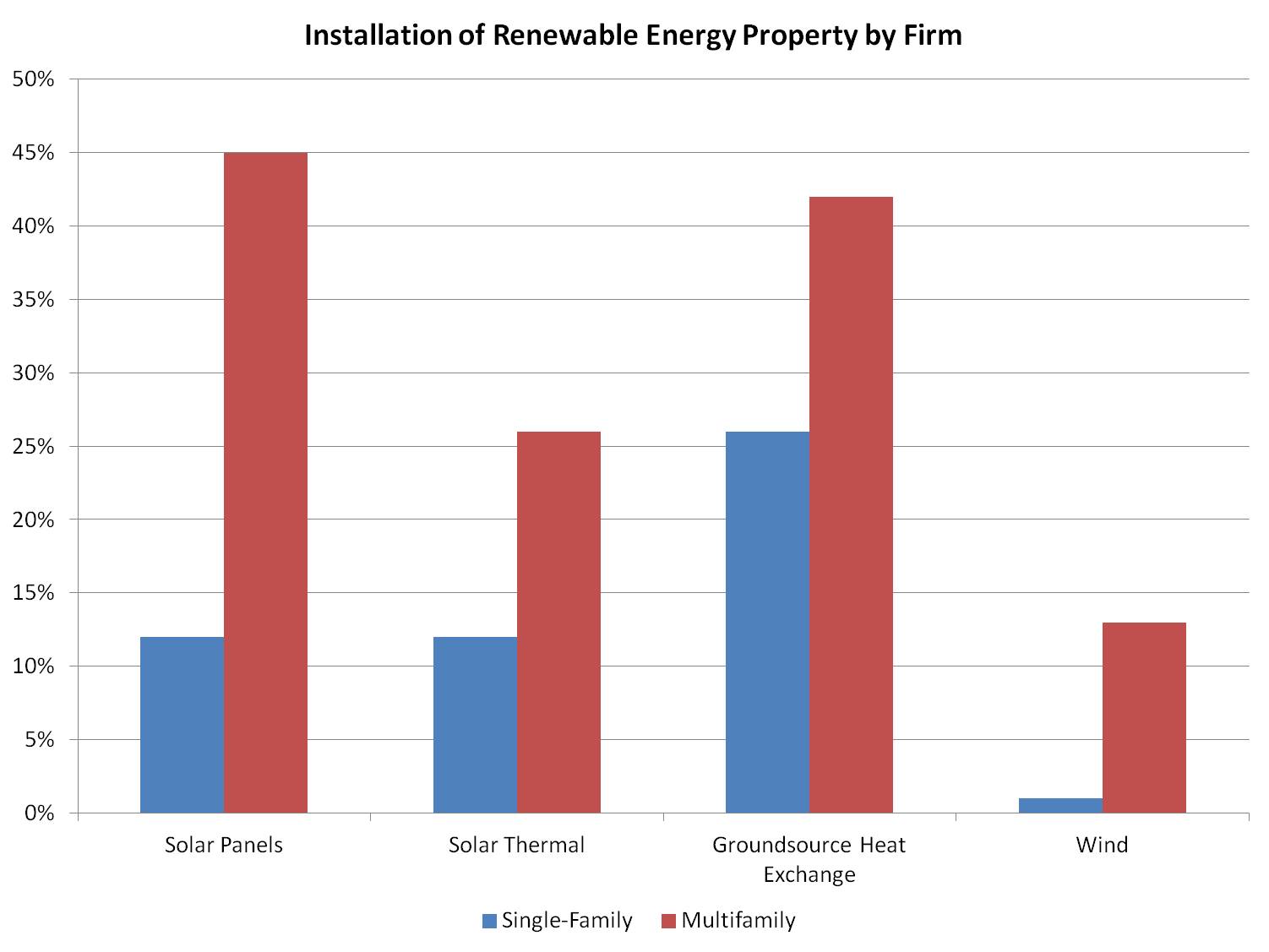
Multifamily developers were more likely to use these power production features in at least some of their projects. For example, 45% of multifamily developers used solar panels, 42% installed geothermal property in some projects and 13% reported using wind turbines.
That said, the frequency of use of these items was more common on the single-family side of the market, perhaps due to incentives like the section 25D power production tax credit for new and existing homes. More than half of single-family builders who report installing solar panels do so on more than 25% of their projects. And more than 75% of single-family builders who install geothermal property do so on more than 25% of their homes.
In contrast, for multifamily developers who report installing solar panels, more than 75% do so on fewer than 25% of their projects. And nearly all multifamily developers who report using geothermal do so on fewer than 25% of their properties.
Monday, August 12, 2013
FHFA seeks to reduce its support of multifamily housing
The Federal Housing Finance Agency (FHFA) is seeking public input on strategies for reducing Fannie Mae and Freddie Mac’s presence in the multifamily housing finance market in 2014.
In keeping with the goal of contracting the market presence of Fannie Mae and Freddie Mac while simplifying and shrinking their operations, FHFA’s 2013 Conservatorship Scorecard included reducing their volume of new multifamily business by 10 percent relative to 2012. FHFA expects this reduction to be achieved this year through a combination of increased pricing, more limited product offerings and stronger underwriting standards.
FHFA is now evaluating alternatives for reducing Fannie Mae and Freddie Mac’s multifamily businesses in 2014 and is seeking public input on the potential market impact of various strategies. These include:
In keeping with the goal of contracting the market presence of Fannie Mae and Freddie Mac while simplifying and shrinking their operations, FHFA’s 2013 Conservatorship Scorecard included reducing their volume of new multifamily business by 10 percent relative to 2012. FHFA expects this reduction to be achieved this year through a combination of increased pricing, more limited product offerings and stronger underwriting standards.
FHFA is now evaluating alternatives for reducing Fannie Mae and Freddie Mac’s multifamily businesses in 2014 and is seeking public input on the potential market impact of various strategies. These include:
- Restrictions on available loan terms;
- Simplification and standardization of loan products;
- Limits on property financing;
- Limits on business activities; and,
- Other options that FHFA should consider to contract the Enterprises’ multifamily businesses.
Tuesday, June 4, 2013
Apartment and Condominium Market Remains Strong after Small Correction in the First Quarter of 2013
The Multifamily Production Index (MPI), released today by the National Association of Home Builders (NAHB), inched down two points to an index level of 52. It is the fifth straight quarter with a reading over 50.
The MPI measures builder and developer sentiment about current conditions in the apartment and condominium market on a scale of 0 to 100. The index and all of its components are scaled so that any number over 50 indicates that more respondents report conditions are improving than report conditions are getting worse.
The MPI provides a composite measure of three key elements of the multifamily housing market: construction of low-rent units, market-rate rental units and “for-sale" units, or condominiums.
In the first quarter of 2013, the MPI component tracking builder and developer perceptions of market-rate rental properties dropped four points to 61, but has been above 60 for seven consecutive quarters—the longest sustained period of strength since the inception of the index in 2003. For-sale units dipped four points to 42, while low-rent units rose two points to 55.
“The apartment sector overall has largely recovered since the downturn, so we have now reached a level of development that is close to equilibrium and can continue at this pace,” said W. Dean Henry, CEO of Legacy Partners Residential in Foster City, Calif., and chairman of NAHB’s Multifamily Leadership Board. “With that said, there are still certain markets around the country that have room to grow.”
The Multifamily Vacancy Index (MVI), which measures the multifamily housing industry's perception of vacancies, rose seven points to 38. With the MVI, lower numbers indicate fewer vacancies. After peaking at 70 in the second quarter of 2009, the MVI improved consistently through 2010 and has been at a fairly moderate level throughout 2011 and 2012.
Historically, the MPI and MVI have performed well as leading indicators of U.S. Census figures for multifamily starts and vacancy rates, providing information on likely movement in the Census figures one to three quarters in advance.
“The multifamily market has recovered substantially since the end of 2010, and is well on its way to reaching a sustainable level,” said NAHB Chief Economist David Crowe. “However, there are still issues facing builders and developers that could have an impact on future production, such as a shortage of labor with basic construction skills and rising prices for some building materials.”
For data tables on the MPI and MVI, visit www.nahb.org/mms.
Monday, May 6, 2013
FHFA Releases Fannie and Freddie Reports on Viability of Their Multifamily Businesses Without Government Guarantees
The Federal Housing Finance Agency (FHFA) today released reports prepared by Fannie Mae and Freddie Mac (the Enterprises) on their multifamily businesses. The reports were conducted at the direction of FHFA pursuant to its goal of contracting Fannie Mae and Freddie Mac’s overall market footprint and generating potential value for taxpayers. As part of the 2012 Conservatorship Scorecard, the Enterprises were directed to analyze the viability of their multifamily businesses absent a government guarantee and review the likelihood of these models operating on a stand-alone basis after attracting private capital and making any adjustments for pricing if needed.
The reports conclude that without government guarantees, the multifamily businesses of Fannie Mae and Freddie Mac have little inherent value. The reports further conclude that the sale of these businesses would return little or no value to the U.S. Treasury and to taxpayers. The reports also highlight the fundamental tensions inherent in the government sponsored enterprise model that policymakers will have to consider as part of housing finance reform.
2012 Conservatorship Scorecard:
The Enterprises’ Reports on a Multifamily Future StateWithout a U.S. Government Guarantee
One of the goals in the Federal Housing Finance Agency’s (FHFA) 2012 Strategic Plan for Enterprise Conservatorshipsis to gradually contract the overall market footprint of Fannie Mae and Freddie Mac (the “Enterprises”). The basic premise is that with an uncertain future and a general desire for more private capital to re-enter the market, the presence of Fannie Mae and Freddie Mac in both the multifamily and single-family housing markets should be reduced gradually over time.
The multifamily lending businesses of Fannie Mae and Freddie Mac are fundamentally different from their single-family businesslines. Multifamily loans are generally much larger than singlefamily loans, they are collateralized by income-producing properties of five or more units, and multifamily lending occupies a much smaller segment of the overall housing market. Moreover, unlike in the single-family market where Fannie Mae and Freddie Mac share risk only on certain loan types, most of the multifamily loans that the Enterprises buy involve some type of risksharing with private capital. Fannie Mae and Freddie Mac’s multifamily businesses are also much less dominant in the marketplace than their single-family businesses and they generally weathered the housing crisis better, generating positive cash flow. New multifamily originations at the Enterprises increased during the financial crisis but have since returned to more normal levels.
Given these differences, FHFA determined that the goal of contracting Fannie Mae and Freddie Mac’s overall market footprint should be approached differently with respect to their multifamily businesses, and it may be accomplished using a much different and more direct method. To evaluate how to accomplish this goal and generate potential value for taxpayers, in the 2012 Conservatorship Scorecard FHFA directed the Enterprises to undertake a market analysis of the viability of their multifamily operations without the government guarantee. Fannie Mae and Freddie Mac were asked to include in their reviews the likely viability of their multifamily business models operating on a stand-alone basis after attracting private capital and adjusting pricing if needed.
The reports from Fannie Mae and Freddie Mac (see attached) conclude that there is little inherent value in their current multifamily businesses without the government guarantee, and that the sale of these businesses without the guarantee would return little or no value to the U.S. Treasury and to taxpayers. In the early years after the sale, the new “stand-alone” businesses would primarily depend on the portfolio asset management fees as a primary source of revenue until their loan production activities were established. Without a government guarantee backing the securities they issue, Fannie Mae and Freddie Mac project that their multi-family businesses would likely occupy a much smaller footprint in the multifamily finance market, with reduced production volume. The businesses would likely be monoline niche specialty finance companies with a focus on non-prime lending and secondary and tertiary market transactions. Their cost of funds and lending rates would be higher and the businesses would rely on the private securitization market or the participation of equity investors to be viable.
While the magnitude of the market impacts cited in the reports deserve further study, the reports highlight a fundamental tension that policymakers will have to consider as part of housing finance reform. Without a government guarantee a fully private company may not provide the same level and scope of services in the marketplace, at least at current prices. For example, Fannie Mae and Freddie Mac conclude that lending on affordable multifamily housing properties, in particular those that satisfy the housing goals, or providing loans to small multifamily properties, may not be practical due to the high cost, relatively low profitability and difficulties with securitization. In addition, without a government guarantee, there may be additional volatility in funding availability under certain economic conditions,similar to other commercial real estate markets.
The reports themselves represent the analysis and views of the Enterprises’ current management teams as reported to FHFA as conservator. FHFA is releasing the reports to enhance public policy discussion of the role of the government in multifamily housing finance, not as an endorsement of the reports’ conclusions.
Without a clear policy path on the future of housing finance reform, including Fannie Mae and Freddie Mac’srole in the multifamily market, and given the limited availability of economically viable disposition options highlighted in the reports, FHFA must still provide direction as conservator and overseer of the Enterprises’ multifamily businesses.Consistent with the goal of contracting Fannie Mae and Freddie Mac’s dominant market presence, FHFA’s 2013 Conservatorship Scorecard put in place a 10 percent volume reduction for the Enterprises’ new multifamily business in 2013. Going forward, FHFA will evaluate how this process worked in 2013, and intends to consider options to continue a path of gradual contraction while awaiting a legislative resolution of the conservatorships.
Links to Reports:
Fannie Mae Report
Freddie Mac Report
The reports conclude that without government guarantees, the multifamily businesses of Fannie Mae and Freddie Mac have little inherent value. The reports further conclude that the sale of these businesses would return little or no value to the U.S. Treasury and to taxpayers. The reports also highlight the fundamental tensions inherent in the government sponsored enterprise model that policymakers will have to consider as part of housing finance reform.
2012 Conservatorship Scorecard:
The Enterprises’ Reports on a Multifamily Future StateWithout a U.S. Government Guarantee
One of the goals in the Federal Housing Finance Agency’s (FHFA) 2012 Strategic Plan for Enterprise Conservatorshipsis to gradually contract the overall market footprint of Fannie Mae and Freddie Mac (the “Enterprises”). The basic premise is that with an uncertain future and a general desire for more private capital to re-enter the market, the presence of Fannie Mae and Freddie Mac in both the multifamily and single-family housing markets should be reduced gradually over time.
The multifamily lending businesses of Fannie Mae and Freddie Mac are fundamentally different from their single-family businesslines. Multifamily loans are generally much larger than singlefamily loans, they are collateralized by income-producing properties of five or more units, and multifamily lending occupies a much smaller segment of the overall housing market. Moreover, unlike in the single-family market where Fannie Mae and Freddie Mac share risk only on certain loan types, most of the multifamily loans that the Enterprises buy involve some type of risksharing with private capital. Fannie Mae and Freddie Mac’s multifamily businesses are also much less dominant in the marketplace than their single-family businesses and they generally weathered the housing crisis better, generating positive cash flow. New multifamily originations at the Enterprises increased during the financial crisis but have since returned to more normal levels.
Given these differences, FHFA determined that the goal of contracting Fannie Mae and Freddie Mac’s overall market footprint should be approached differently with respect to their multifamily businesses, and it may be accomplished using a much different and more direct method. To evaluate how to accomplish this goal and generate potential value for taxpayers, in the 2012 Conservatorship Scorecard FHFA directed the Enterprises to undertake a market analysis of the viability of their multifamily operations without the government guarantee. Fannie Mae and Freddie Mac were asked to include in their reviews the likely viability of their multifamily business models operating on a stand-alone basis after attracting private capital and adjusting pricing if needed.
The reports from Fannie Mae and Freddie Mac (see attached) conclude that there is little inherent value in their current multifamily businesses without the government guarantee, and that the sale of these businesses without the guarantee would return little or no value to the U.S. Treasury and to taxpayers. In the early years after the sale, the new “stand-alone” businesses would primarily depend on the portfolio asset management fees as a primary source of revenue until their loan production activities were established. Without a government guarantee backing the securities they issue, Fannie Mae and Freddie Mac project that their multi-family businesses would likely occupy a much smaller footprint in the multifamily finance market, with reduced production volume. The businesses would likely be monoline niche specialty finance companies with a focus on non-prime lending and secondary and tertiary market transactions. Their cost of funds and lending rates would be higher and the businesses would rely on the private securitization market or the participation of equity investors to be viable.
While the magnitude of the market impacts cited in the reports deserve further study, the reports highlight a fundamental tension that policymakers will have to consider as part of housing finance reform. Without a government guarantee a fully private company may not provide the same level and scope of services in the marketplace, at least at current prices. For example, Fannie Mae and Freddie Mac conclude that lending on affordable multifamily housing properties, in particular those that satisfy the housing goals, or providing loans to small multifamily properties, may not be practical due to the high cost, relatively low profitability and difficulties with securitization. In addition, without a government guarantee, there may be additional volatility in funding availability under certain economic conditions,similar to other commercial real estate markets.
The reports themselves represent the analysis and views of the Enterprises’ current management teams as reported to FHFA as conservator. FHFA is releasing the reports to enhance public policy discussion of the role of the government in multifamily housing finance, not as an endorsement of the reports’ conclusions.
Without a clear policy path on the future of housing finance reform, including Fannie Mae and Freddie Mac’srole in the multifamily market, and given the limited availability of economically viable disposition options highlighted in the reports, FHFA must still provide direction as conservator and overseer of the Enterprises’ multifamily businesses.Consistent with the goal of contracting Fannie Mae and Freddie Mac’s dominant market presence, FHFA’s 2013 Conservatorship Scorecard put in place a 10 percent volume reduction for the Enterprises’ new multifamily business in 2013. Going forward, FHFA will evaluate how this process worked in 2013, and intends to consider options to continue a path of gradual contraction while awaiting a legislative resolution of the conservatorships.
Links to Reports:
Fannie Mae Report
Freddie Mac Report
Thursday, April 18, 2013
NAHB: Housing Starts Rise on Strength in Multifamily in March
Soaring production of multifamily apartments pushed nationwide housing starts beyond the million-unit mark for the first time since 2008 in March, according to newly released figures from HUD and the U.S. Census Bureau. The data show that total starts activity rose 7.0 percent for the month due entirely to a 31.1 percent increase on the multifamily side, while single-family production slipped 4.8 percent from a number that was revised strongly upward for the previous month.
“Today’s report is a reflection of the solid demand that many areas are seeing for rental apartments as young people take that first step into the housing market, which is a very positive development,” noted Rick Judson, chairman of the National Association of Home Builders (NAHB) and a home builder from Charlotte, N.C. “The numbers are also in keeping with our latest surveys that show single-family builders are experiencing some difficulties in keeping up with rising demand for new homes due to increasing construction costs and other factors.”
Calling the latest data a “mixed bag” due to the opposite direction of single- and multifamily starts and a somewhat weaker amount of permit issuance, NAHB Chief Economist David Crowe said that nevertheless, the numbers indicate “a continuation of the slow, methodical march forward” that characterizes the housing recovery. He also noted that “The three-month moving average for single-family starts remained unchanged at 628,000 units in March – which is right on pace with NAHB’s forecast for a 25 percent gain in new-home production in 2013.”
While single-family starts declined 4.8 percent to a seasonally adjusted annual rate of 619,000 units in March, this was entirely due to a substantial upward revision to the previous month’s data, without which virtually no change would have been recorded. At the same time, multifamily housing starts surged 31.1 percent to a seasonally adjusted annual rate of 417,000 units – their fastest pace since January 2006.
Three out of four regions posted gains in combined single- and multifamily housing production in March, with the Midwest registering a 9.6 percent increase, the South posting a 10.9 percent gain and the West noting a 2.7 percent rise. The Northeast was the lone exception to the rule, with a 5.8 percent decline.
Following a large gain in the previous month, total permit issuance fell 3.9 percent to a 902,000-unit rate in March. That decline reflected a 0.5 percent reduction to 595,000 units on the single-family side and a 10 percent reduction to 307,000 units on the multifamily side.
In contrast to the regional starts report, the Northeast was the only part of the country to post a gain in permitting activity in March, with a 24.7 percent increase to 101,000 units. Meanwhile, the Midwest, South and West posted declines of 2.1 percent, 6.2 percent and 10.4 percent, respectively.
“Today’s report is a reflection of the solid demand that many areas are seeing for rental apartments as young people take that first step into the housing market, which is a very positive development,” noted Rick Judson, chairman of the National Association of Home Builders (NAHB) and a home builder from Charlotte, N.C. “The numbers are also in keeping with our latest surveys that show single-family builders are experiencing some difficulties in keeping up with rising demand for new homes due to increasing construction costs and other factors.”
Calling the latest data a “mixed bag” due to the opposite direction of single- and multifamily starts and a somewhat weaker amount of permit issuance, NAHB Chief Economist David Crowe said that nevertheless, the numbers indicate “a continuation of the slow, methodical march forward” that characterizes the housing recovery. He also noted that “The three-month moving average for single-family starts remained unchanged at 628,000 units in March – which is right on pace with NAHB’s forecast for a 25 percent gain in new-home production in 2013.”
While single-family starts declined 4.8 percent to a seasonally adjusted annual rate of 619,000 units in March, this was entirely due to a substantial upward revision to the previous month’s data, without which virtually no change would have been recorded. At the same time, multifamily housing starts surged 31.1 percent to a seasonally adjusted annual rate of 417,000 units – their fastest pace since January 2006.
Three out of four regions posted gains in combined single- and multifamily housing production in March, with the Midwest registering a 9.6 percent increase, the South posting a 10.9 percent gain and the West noting a 2.7 percent rise. The Northeast was the lone exception to the rule, with a 5.8 percent decline.
Following a large gain in the previous month, total permit issuance fell 3.9 percent to a 902,000-unit rate in March. That decline reflected a 0.5 percent reduction to 595,000 units on the single-family side and a 10 percent reduction to 307,000 units on the multifamily side.
In contrast to the regional starts report, the Northeast was the only part of the country to post a gain in permitting activity in March, with a 24.7 percent increase to 101,000 units. Meanwhile, the Midwest, South and West posted declines of 2.1 percent, 6.2 percent and 10.4 percent, respectively.
Monday, April 15, 2013
NAHB: there are 2.25 million multifamily housing properties in the U.S.

Tuesday, December 11, 2012
Apartment and Condominium Market Remains Steady in Third Quarter
The Multifamily Production Index (MPI), released by the National Association of Home Builders (NAHB) today, remained steady with an index level of 52. It is the third straight quarter with a reading over 50.
The MPI, which measures builder and developer sentiment about current conditions in the apartment and condominium market on a scale of 0 to 100, was essentially unchanged in the third quarter, only dropping two points from 54 in the second quarter.
The MPI provides a composite measure of three key elements of the multifamily housing market: construction of low-rent units, market-rate rental units and “for-sale" units, or condominiums. The index and all of its components are scaled so that any number over 50 indicates that more respondents report conditions are improving than report conditions are getting worse. In the third quarter of 2012, the MPI component tracking builder and developer perceptions of market-rate rental properties recorded a level of 69 and has been over 60 for five consecutive quarters—the longest sustained period of strength since the inception of the index in 2003. For-sale units had its highest reading since the fourth quarter of 2005, coming in at 44, while low-rent units dropped 15 points to 46.
“The market-rate apartment and condo markets continue to improve as household formations generate demand,” said W. Dean Henry, CEO of Legacy Partners Residential in Foster City, Calif., and chairman of NAHB’s Multifamily Leadership Board. “As young households find sustainable employment, most are renting in new apartment communities.”
The Multifamily Vacancy Index (MVI), which measures the multifamily housing industry's perception of vacancies, dropped three points 33. With the MVI, lower numbers indicate fewer vacancies. After peaking at 70 in the second quarter of 2009, the MVI declined consistently through 2010 and has been at a fairly low level throughout 2011 and 2012.
“The multifamily market has recovered substantially since the end of 2010, and now stands at about 70 percent of the way back to a sustainable level. Our baseline forecast calls for further steady growth in the rate of multifamily production,” said NAHB Chief Economist David Crowe. “However, there are reasons for concern, especially at the affordable end of the rental apartment market, where builder confidence dropped dramatically in the third quarter. That was likely due to a specific provision of the Low-Income Housing Tax Credit set to expire at the end of the year. The prospect of dealing with this is making lower-rent projects difficult to underwrite. Ongoing deficit-reduction negotiations in Congress need to address this issue, or a serious shortage of affordable rental housing may develop.”
Historically, the MPI and MVI have performed well as leading indicators of U.S. Census figures for multifamily starts and vacancy rates, providing information on likely movement in the Census figures one to three quarters in advance.
For data tables on the MPI and MVI, visit www.nahb.org/mms.
The MPI, which measures builder and developer sentiment about current conditions in the apartment and condominium market on a scale of 0 to 100, was essentially unchanged in the third quarter, only dropping two points from 54 in the second quarter.
The MPI provides a composite measure of three key elements of the multifamily housing market: construction of low-rent units, market-rate rental units and “for-sale" units, or condominiums. The index and all of its components are scaled so that any number over 50 indicates that more respondents report conditions are improving than report conditions are getting worse. In the third quarter of 2012, the MPI component tracking builder and developer perceptions of market-rate rental properties recorded a level of 69 and has been over 60 for five consecutive quarters—the longest sustained period of strength since the inception of the index in 2003. For-sale units had its highest reading since the fourth quarter of 2005, coming in at 44, while low-rent units dropped 15 points to 46.
“The market-rate apartment and condo markets continue to improve as household formations generate demand,” said W. Dean Henry, CEO of Legacy Partners Residential in Foster City, Calif., and chairman of NAHB’s Multifamily Leadership Board. “As young households find sustainable employment, most are renting in new apartment communities.”
The Multifamily Vacancy Index (MVI), which measures the multifamily housing industry's perception of vacancies, dropped three points 33. With the MVI, lower numbers indicate fewer vacancies. After peaking at 70 in the second quarter of 2009, the MVI declined consistently through 2010 and has been at a fairly low level throughout 2011 and 2012.
“The multifamily market has recovered substantially since the end of 2010, and now stands at about 70 percent of the way back to a sustainable level. Our baseline forecast calls for further steady growth in the rate of multifamily production,” said NAHB Chief Economist David Crowe. “However, there are reasons for concern, especially at the affordable end of the rental apartment market, where builder confidence dropped dramatically in the third quarter. That was likely due to a specific provision of the Low-Income Housing Tax Credit set to expire at the end of the year. The prospect of dealing with this is making lower-rent projects difficult to underwrite. Ongoing deficit-reduction negotiations in Congress need to address this issue, or a serious shortage of affordable rental housing may develop.”
Historically, the MPI and MVI have performed well as leading indicators of U.S. Census figures for multifamily starts and vacancy rates, providing information on likely movement in the Census figures one to three quarters in advance.
For data tables on the MPI and MVI, visit www.nahb.org/mms.
Thursday, October 25, 2012
NAHB's fall construction forecast provides an upbeat tone.
Chief Economist David Crowe and his fellow presenters at NAHB's fall construction forecasting event carried a mostly upbeat tone. The focus of the event was regarding the housing industry and the evolution of housing finance policies. The speakers noted that the most recent data seems to be "in sync" with the notion that a recovery is truly underway. Much of the multifamily and single family remodeling has made considerable progress toward returning to pre-down turn levels. Stating that remodeling is already back to 100% of production relative to 2000-2002 spending and multifamily is at 64%, and single family is around 40% of normal production. However, Crowe noted that weak job growth, credit issues, and appraisal problems continue to slow the pace of recovery. This forecast is contingent on Congress coming up with a solution to avoid the "fiscal cliff" posed by mandated government spending cuts.
This year, Crowe is projecting that single-family starts will finish this year at 528,000 units, then rise 26% to 665,000 units in 2013 and another 30% to 865,000 units in 2014. Meanwhile, he expects multifamily starts to finish 2012 with 224,000 units, followed by a modest rise to 238,000 units in 2013 and another gain to 275,000 units in 2014.
The longest to recover will be the local markets, because those were the hardest hit in the housing downturn.
Areas that are at "normal" housing production levels include North Dakota, Washington, D.C., and parts of Wyoming and Texas.
For more information or to read the full article please see NAHB Monday Morning.
This year, Crowe is projecting that single-family starts will finish this year at 528,000 units, then rise 26% to 665,000 units in 2013 and another 30% to 865,000 units in 2014. Meanwhile, he expects multifamily starts to finish 2012 with 224,000 units, followed by a modest rise to 238,000 units in 2013 and another gain to 275,000 units in 2014.
The longest to recover will be the local markets, because those were the hardest hit in the housing downturn.
Areas that are at "normal" housing production levels include North Dakota, Washington, D.C., and parts of Wyoming and Texas.
For more information or to read the full article please see NAHB Monday Morning.
Friday, December 9, 2011
NAHB: Index Shows Continued Improvement for Apartment and Condominium Market
The Multifamily Production Index (MPI), a leading indicator for the multifamily market, released by the National Association of Home Builders (NAHB) today showed continued improvement for the fifth consecutive quarter for the apartment and condominium housing market.
The MPI, which tracks the sentiment of builders and developers about the conditions of the multifamily market on a scale of 0 to 100, increased from 44.4 in the second quarter to 47.3 in the third quarter—the highest reading since the fourth quarter of 2005.
The index provides a composite measure of three key elements of the multifamily housing market: construction of low-rent units, market-rate rental units and “for-sale" units, or condominiums. The index and all of its components are scaled so that any number over 50 indicates that more respondents report conditions are improving than report conditions are getting worse. In the third quarter of 2011, the MPI component tracking builder and developer perceptions of market-rate rental properties recorded an all-time high of 63.8, while low-rent units remained steady at 50.1. For-sale units rose to 31.9, the highest recording since the second quarter of 2006.
“Multifamily construction continues to be the bright spot in the overall housing market,” said NAHB Chief Economist David Crowe. “While household formations have been below trend, those who are forming new households are becoming renters and this trend is likely to continue until consumers’ confidence returns.”
“Apartments and condominiums play an integral role in the overall housing market, now more than ever,” said Stillman Knight, chairman of NAHB’s Multifamily Council Board of Trustees and president and CEO of the Knight Company of Alexandria, Va. “The construction of these units not only brings jobs to local communities, but also provides an adequate stock of housing for areas with rapid population growth.”
Looking forward to the next six months, builder and developer expectations improved in the third quarter for market-rate rental properties and for-sale properties, up to 67.2 and 37.3, respectively. Expectations for low-rent units decreased slightly, to 50.2.
The Multifamily Vacancy Index (MVI), which measures the multifamily housing industry's perception of vacancies, decreased from 36.1 in the second quarter to 35.1 in the third quarter. With the MVI, lower numbers indicate fewer vacancies. The MVI has improved considerably since reaching a peak of 70.2 in the second quarter of 2009.
“NAHB’s Multifamily Production Index and Multifamily Vacancy Index have emerged as leading indicators for the multifamily market,” Crowe said. “For example, the MVI began to improve strongly in the third quarter of 2009, one quarter before a similar trend emerged in the Census Bureau’s rental vacancy rate for buildings with at least five apartments. Although the Census shows a slight surge in rental vacancy rates in the latest quarter, our survey suggests that this will only be a temporary setback.”
For data tables on the MPI and MVI, visit www.nahb.org/mms.
The MPI, which tracks the sentiment of builders and developers about the conditions of the multifamily market on a scale of 0 to 100, increased from 44.4 in the second quarter to 47.3 in the third quarter—the highest reading since the fourth quarter of 2005.
The index provides a composite measure of three key elements of the multifamily housing market: construction of low-rent units, market-rate rental units and “for-sale" units, or condominiums. The index and all of its components are scaled so that any number over 50 indicates that more respondents report conditions are improving than report conditions are getting worse. In the third quarter of 2011, the MPI component tracking builder and developer perceptions of market-rate rental properties recorded an all-time high of 63.8, while low-rent units remained steady at 50.1. For-sale units rose to 31.9, the highest recording since the second quarter of 2006.
“Multifamily construction continues to be the bright spot in the overall housing market,” said NAHB Chief Economist David Crowe. “While household formations have been below trend, those who are forming new households are becoming renters and this trend is likely to continue until consumers’ confidence returns.”
“Apartments and condominiums play an integral role in the overall housing market, now more than ever,” said Stillman Knight, chairman of NAHB’s Multifamily Council Board of Trustees and president and CEO of the Knight Company of Alexandria, Va. “The construction of these units not only brings jobs to local communities, but also provides an adequate stock of housing for areas with rapid population growth.”
Looking forward to the next six months, builder and developer expectations improved in the third quarter for market-rate rental properties and for-sale properties, up to 67.2 and 37.3, respectively. Expectations for low-rent units decreased slightly, to 50.2.
The Multifamily Vacancy Index (MVI), which measures the multifamily housing industry's perception of vacancies, decreased from 36.1 in the second quarter to 35.1 in the third quarter. With the MVI, lower numbers indicate fewer vacancies. The MVI has improved considerably since reaching a peak of 70.2 in the second quarter of 2009.
“NAHB’s Multifamily Production Index and Multifamily Vacancy Index have emerged as leading indicators for the multifamily market,” Crowe said. “For example, the MVI began to improve strongly in the third quarter of 2009, one quarter before a similar trend emerged in the Census Bureau’s rental vacancy rate for buildings with at least five apartments. Although the Census shows a slight surge in rental vacancy rates in the latest quarter, our survey suggests that this will only be a temporary setback.”
For data tables on the MPI and MVI, visit www.nahb.org/mms.
Wednesday, November 2, 2011
NewGeography report finds that more Americans are moving to detached housing
Conventional wisdom, the national media, and planning professionals would have you believe that Americans are moving to attached housing (apartments and condominiums) in droves. A report by NewGeography finds reality defies that conventional wisdom.
NewGeography analyzed the top 51 housing markets (over 1 million population) and compared Census data from 2000 and 2010. The results of their findings include:
NewGeography analyzed the top 51 housing markets (over 1 million population) and compared Census data from 2000 and 2010. The results of their findings include:
- Single-Family Detached housing attracted 79.2 percent of new households
- Multi-Family Attached housing attracted 11.8 percent of new households
- Two-Unit Attached housing attracted 11.3 percent of new households
- Other housing, like mobile homes and boats, declined by 2.3 percent
A total of 4 million new new single family homes were added in the 51 markets, while apartments and condominiums added 590,000 units and attached houses added 570,000 units.
Planners argue that condominiums tend to be more attractive in larger housing markets due to higher land costs. However, planners and demographers do anticipate a slight shift in preference to attached housing in the coming decades as Generation Y enters the housing market.
Wednesday, September 28, 2011
Multi-family housing market continues to strengthen
While single-family housing production remains relatively weak, multi-family housing continues to strengthen across the country. Future home buyers continue to sit on the sideline and instead have opted for renting or have purchased town homes and other non-traditional housing.

NAHB’s multifamily production index (MPI) rose for a fourth consecutive quarter in the second quarter of 2011 to 44.4. It is the highest quarterly reading since 2006, and continues the trend of generally improving conditions in the market for new multifamily housing that has emerged since the MPI dropped to a record low of 16.0 in the third quarter of 2008.
The index and all of its three components (construction of low-rent units, construction of market-rate-rent units, and construction of “for sale” units) are scaled so that any number over 50 indicates that more respondents report conditions are improving than report conditions are getting worse. In the second quarter of 2011, a majority of developers saw improvements in the production of low-rent and market-rate units. Looking forward, most developers expect conditions to continue improving for these two segments of the market.
Meanwhile, the Multifamily Vacancy Index (MVI) increased slightly from 35.0 in the first quarter of 2011 to 36.1 in the second quarter. With the MVI, lower numbers indicate fewer vacancies. Results also show that multifamily developers and property owners expect vacancy rates to decline over the next six months.
NAHB’s multifamily production index (MPI) rose for a fourth consecutive quarter in the second quarter of 2011 to 44.4. It is the highest quarterly reading since 2006, and continues the trend of generally improving conditions in the market for new multifamily housing that has emerged since the MPI dropped to a record low of 16.0 in the third quarter of 2008.
The index and all of its three components (construction of low-rent units, construction of market-rate-rent units, and construction of “for sale” units) are scaled so that any number over 50 indicates that more respondents report conditions are improving than report conditions are getting worse. In the second quarter of 2011, a majority of developers saw improvements in the production of low-rent and market-rate units. Looking forward, most developers expect conditions to continue improving for these two segments of the market.
Meanwhile, the Multifamily Vacancy Index (MVI) increased slightly from 35.0 in the first quarter of 2011 to 36.1 in the second quarter. With the MVI, lower numbers indicate fewer vacancies. Results also show that multifamily developers and property owners expect vacancy rates to decline over the next six months.
Subscribe to:
Posts (Atom)